Catch this breath
October 24, 2011 § 2 Comments
Yellow against a blue sky. Fall out here is mostly yellow with a few dashes of red. I am thrilled with the fiery maples outside my apartment, like red candle flames flickering in the wind. The wind hasn’t blown them out. Yet. But already small leaves lie in the grass, and more will follow, one after another, as always, as the seasons fulfill themselves.
This week’s fall happinesses: Orange spice black tea. Maple syrup popcorn balls. Pumpkins, big and small, orange and white, smooth and bumpy. A warm mug of coffee in cold morning hands. My caramel-golden dog in the afternoon light, her coat complementing the fall colors as if she belongs with them, and so she does.
This is a passing moment. Such a beloved season of the year for so many people, including me, and I keep thinking about how I’ve got to take a picture of this tree, that barn, this week – or the season’s colors and textures might be gone. I am having camera troubles again – a new one may need to be on the Christmas list this year, or baby brother might need to have a look at this one the next time that I get to see him. Meanwhile it is instinctive for me to want to stop and get a shot, and frustrating to be unable to. And yet, can I turn this around and make it a good thing? Yes. I can pause a moment longer not for a photograph but for me. To notice with my own eyes, to linger to find the details, to take the time to capture these things not in a digital form but in my memory.
Yesterday Miss T. and I stopped by Coot Lake, just before sunset faded into twilight. The water looked deep blue in the shade, but in the open its peaks were lit white by the sun. A flock of ducks floated around near the shore, black silhouettes under the glowing leaves. We walked a path of gold and red, beneath arching limbs, and everything felt at once lit-up and cloaked in shadow.
The path takes you down to the reservoir, and T. and I skidded down the side of a slope and meandered through the drained, patterned surface where the water had receded. Far from the water the ground had already turned crusty, forming a series of solid little bumps and ridges. Closer to the water the ground became mud, also rippled but interrupted with a few trails of paw prints. Light rested on the surface of the water, making it silvery-white with the intensity of the low sun, just about to dip behind the mountains. A flock of geese lingered beyond, their necks long and graceful and black, their wings folded against their bodies as they floated in one group. Miss T. glanced at them, skipped a few feet in the water, watched as they lifted off to settle a few yards further from her, the potential predator.
The dog came back to sidle past me with her tennis ball, her eyes meeting mine all dark and glad. I tell myself this is why I need to bring her out to run and play more often. She is an animal, and though I am terribly glad she is my domesticated darling, it is good that she has a few moments of freedom, a few more sniffs at what is wild. I know I need this. These are evenings of remembering what to connect to. Where we are from.
The weather websites are predicting snow for Wednesday. Everyone speaks caution, prepares for changes in routine. I love snow and am not generally growly upon winter’s arrival – I tend to open my wool-clad arms and mittened hands to it! But the fall of these past two weeks has been so perfect, just absolutely what one wishes for, and I feel the need to cling to it for awhile.
It feels like I’m holding my breath. Stay. Stay, just a little longer.
From reservation to boarding school
October 12, 2011 § Leave a comment
My first new-library-card book checkout has turned out to be a success. (No wanting to throw the book across the room because the writing style is so dreadful or the characters so stereotyped. Hooray!) Linda LeGarde Grover’s short story collection, The Dance Boots keeps me coming back, to be inside the world she creates, to try and know its inhabitants. Grover writes prose with a strong poetic quality, her lines rhythmic and her images rich. The voice changes subtly, but enough, as different characters narrate their stories. And her characters are vulnerable, strong, complex. You want to know them. A few times I did get a little confused as to where we were in time and who happened to be narrating, as the scenes frequently jump, but that’s my only complaint – and may not be an issue for readers with less of a tendency to daydream! If you’re looking for a primarily plot-driven book, this isn’t the one. If you’re looking for a book that explores the human experience – particularly, the influence of Indian schools and white culture on the Ojibwe of Northern Minnesota – this is one you’ll want to be sure to get your hands on.
Here’s an excerpt:
And mother was beautiful – the sum of all she was, was beauty. In her white low-waisted dress with the embroidery down the left side of the skirt. In the dress she wore to powwows, black cotton with red tape trim, cones rolled from snuff can covers sewn on the hem, the pleasant jingle they made as she walked and as she danced next to her dear friend Lisette, off to the side of the powwow circle, swiveling slowly, nine steps left, nine steps right. Lisette, she was called, and Mother was called Shonnud. Lisette was a maple tree, strong and stately, Shonnud an aspen that trembled to the music that moved the still air.
. . . Their dancing was hard work, controlled, disciplined, and prayerful; their calves were trim and very firm from this dancing, their feet muscular. And I watched them and waited for the day that I would be a young lady in a black dress and beaded jacket, waited and watched them dance as they had since they were young ladies, Shonnud and Lisette dancing side by side, dipping gracefully in a rhythm deeper in the hearts and souls of women than the drumbeat. (Grover 93-94)
The book won the Flannery O’Connor Award for Short Fiction, which is placed in such small print on the cover I didn’t even notice until a moment ago. This is encouraging – see, I do have good taste! More seriously, I am just encouraged by happening upon writing that insists upon being art, not just entertainment. Writing that reads naturally, that masks the effort put into the work. Like a ballet.
Wind in their manes
October 7, 2011 § Leave a comment
The wind blew and blew and blew today. Yesterday afternoon it began, and kicked dust into my eyes as I headed into the Therapeutic Riding Center for my volunteer time. As we waited for our riders and the horse leaders tacked up the horses, out in the half-sheltered grooming area, we kept having to squint and turn our faces. The indoor arena where we had the lesson was quieter, but still came the sound of the wind against the walls.
At the boarding stable that night I looked west to see the sky all blue-gray, and a cloudy white mist suggested snow falling in the mountains. The horses trotted anxiously and tossed their heads. Hurry up! The storm is coming! They wanted their food and their paddocks with their sheds for shelter. We wanted that, too, but it takes time! Hungry horses riled up by wild winds make for an interesting night, but I am lucky in my coworkers. We manage to be careful and focused yet able to laugh at the same time.
So the wind whipped my ponytail and blew through the manes of those lovely horses as they hurried through gates, and at the end of the day I was glad to come home to soup and crackers and my friendly roommate and of course my darling dog.
Woke up this morning to cold air and a pink sunrise. Hurry up, Tassie. The poor dog hears me say it every morning, first thing, while I stand outside in slippers or bare feet waiting for her to do her little business, because I’m always staying in bed until I absolutely must get up or be terribly late. And she usually kind of hurries, because she wants her food (which she gets next), but this morning I had to chase her as she decided to wander far from her usual spot into a cluster of pines. Tass! Come on. And I was late, but not by very much, at least, and I had time to grab a sweatshirt.
Oh, it was a shocking kind of cold this morning – our bodies have been so adjusted to heat thanks to this summer, and even earlier this week I was growling to myself about when the heat would please leave. In the early hours of this day I wore gloves, a winter hat, pulled up my hood, wriggled my numb toes in their boots to try to get blood flowing. All of us sniffed all morning as we brought in the harvest – fortunately, no frost last night! Just the wind blowing from the West, down over Long’s Peak to the farm.
The sun came and the shadows moved out of the way, and by mid-morning I was down to a cozy hoodie. A chorus of blackbirds had settled into two or three trees on the outskirts of the farm, and noisy, they were! Perhaps fussing just as the humans have been – all warning one another about the likelihood of rain and the possibility of snow tonight. I doubt snow will come, especially this soon. It sits on the mountains and teases me most of the winter. But you never know!
We shall see how the market goes tomorrow, with the forecast of “Light drizzle for most of the morning. Cold.” These are most definitely days for dressing in layers, and bringing along just-in-case items. I will wear merino and a scarf, grab a puffy vest and my raincoat, and throw an extra pair of wool socks into my market bag. Bring on the weather, October!
Waiting for frost
October 6, 2011 § Leave a comment
We check the weather every day. When the frost comes, everything changes, and quickly. What will survive – and for how long? What won’t?
Growers and producers set up farmers’ markets and CSA shares around specific dates, carefully defined growing seasons. But the frost makes the real call as to how long the farm will continue to be in production.
Do we humans control nature? Sometimes, and sometimes too much. But the weather reminds us that in the grand scheme of things, we have to fit within the earth’s habits and patterns. We can make the most of them, and adapt to them. We can use such things as hoop houses and greenhouses and row covers and mulches for the fields, sheds and heat lamps and straw and water holes and fans for the livestock, to support better and longer growth and survival. But we can’t force nature’s hand. We have to follow it, and pay attention to it. Sometimes we hate it. We learn to respect it.
My grad school friend Mae Rose Petrehn talks all the time about grazing practices, and holistic management in particular. (She’s currently grazing several hundred sheep on a ranch in Nebraska.) Here’s a link to an article in The Atlantic about cattlemen who are looking at new (old) ways of having ruminants on the land, grazing in a way that emulates how nature would have it done in the wild, in order to restore landscapes in addition to producing food.
Lisa M. Hamilton writes: “The basic premise of holistic management is to use livestock like wild animals. But whereas bison on the Great Plains moved through the landscape by instinct, now ranchers must supply that direction. Rather than simply turning cattle into a pasture, these ranchers conduct them like a herd, concentrating bodies to graze one area hard, then leaving it until the plants have regenerated. The effect can be tremendous, with benefits including increased organic matter in the soil, rejuvenation of microorganisms, and restoration of water cycles.”
Read the article! The Brown Revolution: Increasing Agricultural Productivity Naturally.
There is a kind of tension that can exist when one’s livelihood and/or survival depends on nature. But we are kidding ourselves if we think that only applies to some people. It applies to all of us, as nature’s resources feed, clothe, and shelter us – even if we have so distanced ourselves from the process of production that we forget this reality. So we would be wise to explore the tension, to avoid the downfall of domination, and to move as much as we can towards harmony.
So long, September
September 30, 2011 § 3 Comments
I will send September out in high style this Friday night, with a long bath and Country Living, re-warmed homemade chicken soup with rice, and an early bedtime.
But first, here is the John Keats poem I feel the need to re-read and remind everyone of this time of year. You may want to put on your literary thinking cap since it’s all old language and meter and rhyme, but it’s a gorgeous piece and worth the time. Can’t you just imagine England in the fall? I was there in the gloomy winter/spring, but I can imagine. And I’m remembering so many pastoral paintings, hanging on the walls of European museums, by artists whose names I wrote down on scraps of paper, and shoved in my pockets, and inevitably lost.
—–
To Autumn
Season of mists and mellow fruitfulness
Close bosom-friend of the maturing sun
Conspiring with him how to load and bless
With fruit the vines that round the thatch-eaves run;
To bend with apples the moss’d cottage-trees,
And fill all fruit with ripeness to the core;
To swell the gourd, and plump the hazel shells
With a sweet kernel; to set budding more,
And still more, later flowers for the bees,
Until they think warm days will never cease,
For Summer has o’er-brimm’d their clammy cells.
Who hath not seen thee oft amid thy store?
Sometimes whoever seeks abroad may find
Thee sitting careless on a granary floor,
Thy hair soft-lifted by the winnowing wind;
Or on a half-reap’d furrow sound asleep,
Drows’d with the fume of poppies, while thy hook
Spares the next swath and all its twined flowers:
And sometimes like a gleaner thou dost keep
Steady thy laden head across a brook;
Or by a cider-press, with patient look,
Thou watchest the last oozings hours by hours.
Where are the songs of Spring? Ay, where are they?
Think not of them, thou hast thy music too,-
While barred clouds bloom the soft-dying day,
And touch the stubble-plains with rosy hue;
Then in a wailful choir the small gnats mourn
Among the river sallows, borne aloft
Or sinking as the light wind lives or dies;
And full-grown lambs loud bleat from hilly bourn;
Hedge-crickets sing; and now with treble soft
The red-breast whistles from a garden-croft;
And gathering swallows twitter in the skies.
The sunflowers are done
September 29, 2011 § Leave a comment
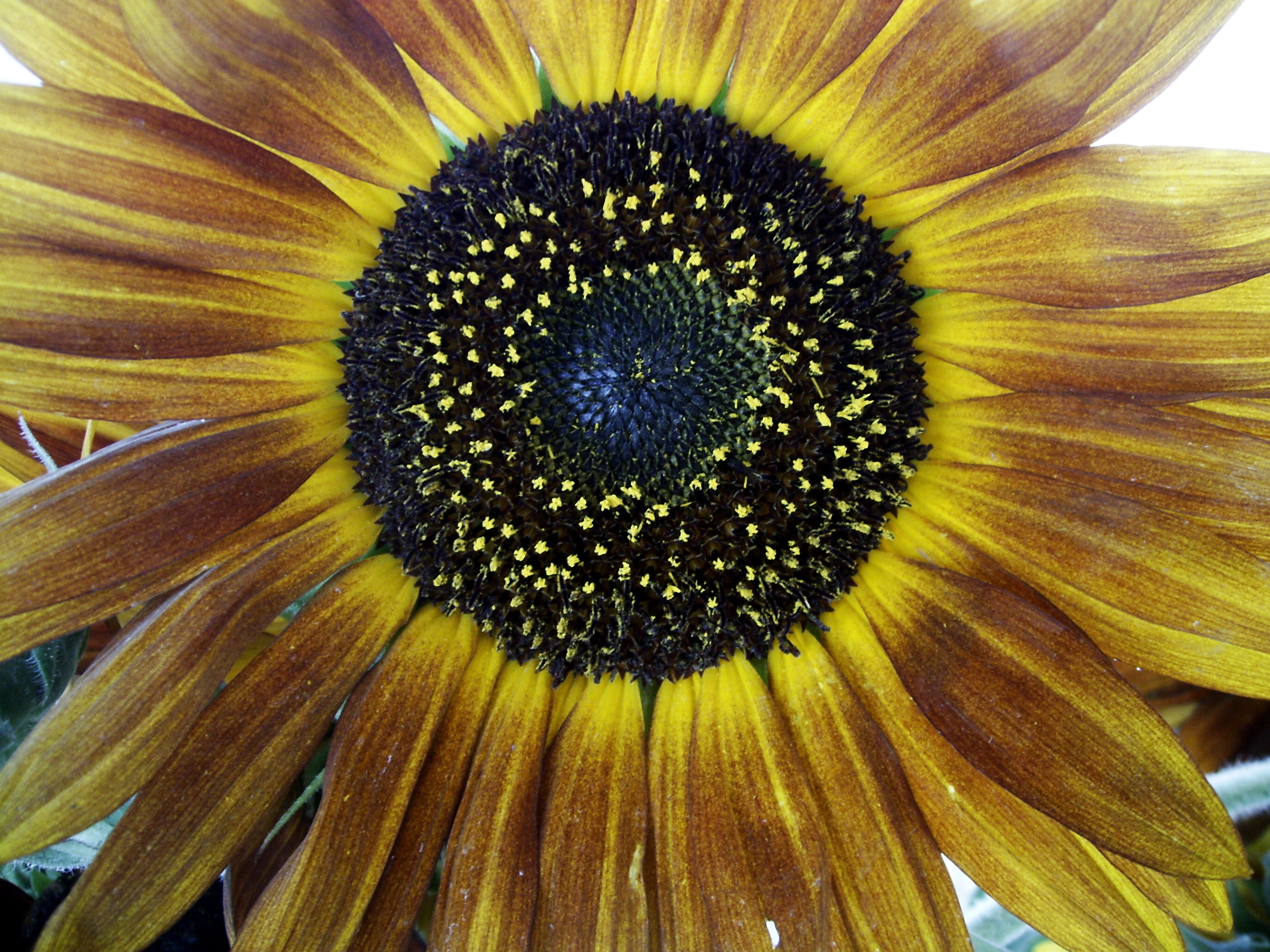
We pulled the stalks out of the ground this week, taking care to save some of the heads for harvesting seed. So here is a last sunny face for you! Till next summer.
Flight
September 27, 2011 § Leave a comment
The other night the sky turned so luminously pink it caught my attention from where I had busied myself indoors. I was chatting on the phone with my mother or sister when the sky beckoned me out onto the patio. I walked out onto the cement, maneuvered around the bicycles, the table, and the tomato plants, and looking out over the trees and garages and parking lot and lampposts I saw them: three skydivers, their parachutes pulled, floating down through the sunset.
We see skydivers out here all the time – Longmont seems to be a city of the sky, with numerous small planes, air shows, hot air balloons, and a skydiving outfit – so it wasn’t unusual to see the figures falling. Usually I don’t envy them, as I am happy enough keeping my money and staying on the ground, but this night I did, a little. They weren’t looking at the sky-canvas, as I was – they were in it. They had become a part of that sunset. I imagine they could practically feel its colors.
Yesterday, while we were picking beans, a great flock of small black birds went racing right over us. Their noise caught our attention and we looked up to see their silhouettes against the blue-and-white. There had to be hundreds of them, all flying at the same speed, one body with one purpose. “It’s like a pattern,” I said, and wished I could sew a dress out of the fabric.
At the barn that night, I watched the birds gather on the fences of the runs where the horses eat. They wait for the horses to finish their feed, and once we pull the horses and buckets out of the runs, the birds hop in for the spilled grain. Mostly they are sparrows, but one of the birds was different, bigger than the rest, a kind of brindled brown and black. I don’t know what he was, and I still haven’t found out, but I kept looking back at him, wanting to see if he got the leftovers along with the others, wondering where he lived and how he had come here.
And all these things came together to make me start thinking about wings. That old human desire for flight. An airplane doesn’t quite suffice – it’s so inside, so loud, so mechanical. I’d rather grow wings out of my own back, nice white feathery ones, tinged pink or gold, that I could tuck away and unfold as needed. I’m not an angel of the heavenly variety nor the (rather opposite) Victoria’s Secret variety, but I do envy their gorgeous feathers! I wonder what kinds of things might we see, if we could add that other dimension of space to our daily, usual movement? How would our perspectives change? What beauty might we know?
Adventure isn’t something I can very well afford right now, but I can daydream about hang-gliding, parasailing, boat sailing, ballooning, and galloping bareback across a meadow. Lightness, height, speed . . . we pursue these things for a reason. I want to do it. I want to find out why.
Natural habitat
September 22, 2011 § 6 Comments
There is a small private lake – probably more accurately a pond – that I go past on my way to the horse barn. Sometimes, as I am passing, the wind carries a lake-water smell on it. I practically gasp it in. Those are times when my whole self aches for Minnesota.
So I felt that ache tonight, going past after I finished my shift, and then turned my head to see a stunning peach-pink glowing from behind the mountains. At the same time that I thought,
Oh, how beautiful!
I also thought,
I miss rolling land and lush foliage and I am tired of it. I want to see a blazing deciduous forest, cattails at the lake’s edge, and a pasture that has known plenty of rain. I want to see them now.
I imagined pushing the mountains down into the ground and letting green spread over everything, green turning to orange and red, the whole landscape anticipating a golden autumn followed by a deep winter.
And I got home feeling all at once homesick, lonely, disgruntled, impatient, and finally guilty. Isn’t it horribly selfish and fussy to be in a place that some find to be the utmost of beauty and to wish for another kind of beauty? There are things I like about it – things that strike me as marvelous, rustic, whatever, here and there – and I love to document these things and share them and appreciate them. But nothing ultimately fits. It’s like seeing a beautiful dress in a store but knowing you aren’t the one meant to wear it. It’s beautiful, but it’ll look better on your brunette friend with the curves and the wide smile. And you shall have the cotton sundress in the next shop down.
It just makes me wonder: what makes some landscapes fit one person so well, and some fit another? It can’t be only nurture, because lots of people end up loving and belonging to landscapes that weren’t their childhood homes. Some people love certain new landscapes and environments right away. Others don’t. Because life is not easy and not fair all of the time, we can’t always decide where we get to be and when. So what if the places where we end up don’t fit us? What if we are of the temperament that makes it very important to us to find joy-peace-and-inspiration in our surroundings? How long can it take for a person to adapt – and can we, fully, ever?

 Kinds of Honey